
Of Achille's heel and Krishna's sole

Some time ago, I read this thing which intrigued me.
Which was that, the Greek hero Achilles and the Hindu deity Krishna die in the same way: by an arrow to the heel.
Somehow, I had never made that connection. Why should they die in the same way?
That got me thinking about this connection. Is there a meaning here?
Let’s start from the beginning.
We all know why Achilles dies the way he does.
His mother Thetis dips him the River Styx to make him immortal. She dips his entire body, but the part she gripped in her hand, the heel, is untouched by water. That is why it is the only weak spot in Achilles’ body is his heel. Achilles’ heel is a famous idiom in English, meaning single, but fatal, weakness.
I tried to look for a similar story in Krishna’s life. Is there any particular reason his feet are vulnerable? Any moment in life when he was dipped in immortality-giving waters, but his heel missed out?
No, I could not think of any such story. But then, something seemingly unrelated popped up in my mind. A story that is strangely, almost exactly, opposite of the story of Achilles and Thetis.
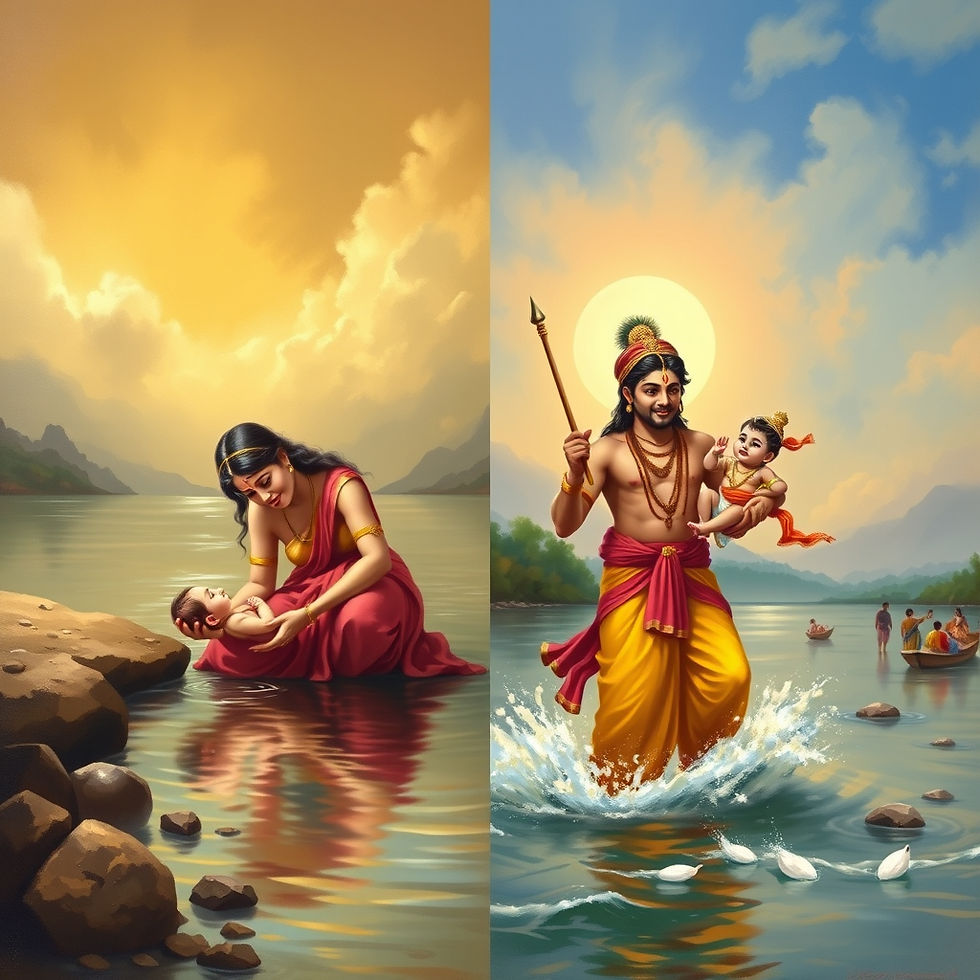
When Krishna is born, his father Vasudeva carries him to the home of his friend Nanda, the Gopa. Nanda’s home in Vrindavan is across the river, Yamuna. As Vasudeva walks across the river, it starts raining. Sheshnag, the divine serpent of Vishnu, glides behind Vasudeva, spreading his fangs over the head of Vasudeva like an umbrella. This much is in Bhagavat Puran, the major source of this story.
What follows is popular in folklore, but apparently not a part of Bhagavat Puran.
As Vasudeva walks on, the river rises in spate. Not necessarily because of rains. But because Yamuna realizes who it is that Vasudeva is carrying, and is eager to touch him, to express her devotion by touching his feet, more specifically. The river rises higher and higher, and eventually rises up to Vasudeva’s navel, his chest, and his neck. Vasudeva is forced to carry Krishna above his head. And still the river rises. Vasudeva is now panicking. What if the river completely swallows him and his son? Just When Vasudeva is at the point of drowning, Krishna, finally understanding the wish of Yamuna, decides to dangle his feet out from his little basket. Yamuna rises high for one last time, a final, exuberant splash that succeeds in touching the tips of Krishna’s toes. And then, suddenly, she recedes, giving way to Vasudeva.
Now here are the opposites: Achilles’ mother dips him into water, leaving only his heel out.
Krishna’s father keeps him away from water (notice that no part of Krishna’s body gets wet, on account of Sheshnag umbrella), but the tips of his toes get wet despite his efforts.
Hmm.
Is there meaning here?
Let us begin by assuming that since both these stories fall under the umbrella of Indo-European mythology, they both originated from the same common corpus of tales. Which probably means that long ago, there was this one story where the presence of water and its absence on the heel meant the same thing. However, the two stories of Achilles and Krishna spread and developed so far from each other that they probably lost that common thread, whatever it was, and so lost the shared meaning as well.
Does the opposition mean that Krishna’s toes are invulnerable, since only the toes got wet? Or is the meaning of water completely opposite in two stories – its absence making Achilles’ heel vulnerable, and its contact making Krishna’s toes vulnerable? Maybe at some point the story was that Krishna was shot in his toes. I think that is it. The Sanskrit word in Mahabharata for where Jara shot Krishna is पादतल, meaning sole of foot. At first glance, this seems to mean heel. But on second thoughts, this could easily mean any part of the sole, including under the toes. That Jara was able to shoot this part of Krishna’s body seems possible in the text, where Krishna was “stretched on the earth in high Yoga”. Yes, I think I have the meaning of the story here. Vasudeva’s father was trying to protect Krishna that night, and Sheshanag aided him. But somehow, despite all this care, a drop of water did manage to get on Krishna’s sole, rendering him vulnerable. That was a very powerful night, with very powerful waters cascading down from heavens and roiling from below.
So here is my theory: Water protected Achilles and he was vulnerable where water was absent. But water destroyed Krishna, he was vulnerable where it touched him.
However, nothing in Hindu literature substantiates this theory, and looking to Greek literature and establishing (not parallels but) opposites sounds farfetched, at best.
Apparently I am so eager to establish connections in motifs shared across continents that I am seeing meaning where there is none.
At moments like this I turn to AK Ramanajun, who has documented countless phenomena like this, where myths share motifs but mean different things. I don’t remember his quote verbatim, but he says something like, in folk literature, stories dip freely from a pool of symbols, but each story uses each motif/symbol in its own way, so that the meaning is different in each story. Hence, looking for the same meaning in each story does not make sense. We have to evaluate the meaning of each motif in each story separately.
Only this makes sense to me. If we say that one motif means only one thing, which is the trend in a lot of Hindu communities, we risk becoming fundamentalist, and that’s not a good thing.
But I digress.
Let us go back to the meaning of these two stories.
Water, earth, heel, toes, all of these things mean many things at many levels in these stories.
One meaning I recently read of the Achilles’ story stands out.
That a mother’s love tries to change destiny, but cannot. That ultimately nothing can change destiny.
Thetis perhaps knew that Achilles was destined for war and glory, and wanted to protect him from wars. She tried, and she failed.
We cannot find the same meaning in Krishna’s relationship with the heel, so the same motif does not give same meaning. However, a different motif is used to give this same meaning in Mahabharata.
Let us turn to Duryodhan, the main villain in Mahabharata. Like Thetis, his mother tried to protect him from inevitable destiny. And like Thetis, she failed.
Duryodhan’s mother is Gandhari, an epitome of female submission to patriarchy in some ways. Because her husband is born blind, Gandhari decides that she will not enjoy the sensual pleasures denied to her husband, and thus blindfolds herself when she weds Dhritarashtra. This much is found in the text.
What follows is, again, folklore, and not part of Sanskrit epic.
Gandhari, being a person of great devotion, accrues great ascetic powers in her gaze which she keeps blindfolded. When it is decided that her sons the Kauravas will go to war with the Pandavas, she decides to make use of that gaze to protect the eldest and strongest of her sons.
Perhaps she knows in her heart of hearts that Duryodhan will come to face Bhimsen, the largest and strongest of the Pandavas and not the best known for righteousness.
And so it is that she asks Duryodhan to come meet her, be present for the moment when she will open her eyes after several years of closing them.
She has one condition: he must be completely naked, without a single thread of clothing on his body.
She intends to bestow all the powers of her gaze on him, make his body harder than adamant, invincible.
However, she, too, has not bargained for destiny, which Duryodhan meets in the form on Krishna, the trickster, as he is walking to meet his mother, naked according to her instructions.
Where goes the prince? asks Krishna. Naked as the day he was born!
I go to meet my mother, says the guileless Duryodhan (for all his sins, Duryodhan was not known for his cunning). She is to open her eyes tonight, and she wishes for me to be present.
A grown man, presenting himself naked to his mother? Asks Krishna, affecting great astonishment. Have you no shame?
Duryodhan is immediately ashamed.
At the very least, cover your private parts! Krishna admonishes, before going on his way.
Duryodhan does exactly that, and we all know how that ends. Every part of his body is adamant, except his crotch. And that is exactly where Bhimsen, not known for playing fair, lands the fatal blow in the great war of Kurukshetra.
So there we have, a mother who tried to protect her son, but realizes that she cannot change destiny. Slightly different incidents, same meaning.
Back to AK Ramanujan: motifs travel, meanings travel, and combinations of motifs and meanings are changed in every story.
The motif of mother, son, protection, failure, destiny, is found in Achilles and Duryodhan. The motif of death by an arrow to the heel is found in Achilles and Krishna, and an attempt to establish similar background stories failed. What I am trying to say is, none of them are universal facts. Each story is unique and its meaning must be evaluated separately in specific contexts.
As for the meaning of Krishna’s story, I will go back to my favorite theory: that originally, Krishna was a mere mortal in the story of Mahabharata. Over time, stories accumulated and led to his deification. The story of his death is one more proof that he was mortal. His death was as random as any other human’s. He was as vulnerable as anyone else.
And even if we look at Krishna as a god, the story makes equal sense. Not even deities are omnipotent, even gods must live and die and face the consequence of their actions.



Comments